Electrified vehicles for sale at Saka are inspected using the Austrian Aviloo battery test, an independent electric vehicle battery test. It shows the battery's actual condition in easy-to-understand graphs and charts, comparing the current state to the original capacity. The result is a clear percentage between 0 and 100%.
What does the test do?
Aviloo reads the electric vehicle's battery pack at the cell level and analyzes it by comparing the data to thousands of other vehicles of the same model, benchmarked against their original condition. The result is a State of Health (SOH) percentage, which indicates how much of the original battery capacity remains.
The vehicle details include individualized information so you can confirm that the test applies to the exact car you're interested in. You can compare the VIN number to the condition report to verify that the data belongs to the same individual vehicle. You can also see where and when the test was performed.
The analysis produces an SOH reading as a percentage, along with the current capacity (in kilowatt-hours) and the WLTP electric range. Current values are shown in blue and original values in black.
SOH – What do the percentages mean?
SOH | Rating | What it means |
90–100% | Excellent | Practically a like-new battery. The driving range matches the original. Even in new and low-mileage electric and hybrid vehicles, battery health typically drops by a few percent during the first few years. |
80–89% | Good | Normal wear relative to age and mileage. Over the long term, electric vehicles tend to settle into this range if there are no issues with the battery. |
< 80% | Attention | The driving range is shorter than the original, but the battery does not necessarily have a problem yet. In plug-in hybrids, the battery may have been cycled from full to empty frequently in a short period of time, which can reduce capacity even if there is no actual fault. |
What does kilowatt-hour mean?
The battery capacity of electric vehicles and plug-in hybrids is measured in kilowatt-hours (kWh), and energy consumption is expressed in kilowatt-hours per hundred kilometers (kWh / 100 km).
Electric vehicles typically consume around 15–25 kWh of electricity per hundred kilometers during normal driving, depending on the vehicle's size, power, and aerodynamics. By dividing the battery's kilowatt-hours by the vehicle's average consumption (e.g., battery size 60 kWh / average consumption 20 kWh / 100 km), you get a rough estimate of how far the car can travel on a single charge — in this example, 300 kilometers.
An electric vehicle's energy consumption also varies based on tires, wheels, and weather conditions, just like a combustion engine vehicle. The effect may be more noticeable than in a combustion engine vehicle.
What does WLTP range mean?
WLTP stands for "Worldwide Harmonized Light Vehicles Test Procedure." It is a standardized EU test used to measure how much fuel and/or energy a vehicle consumes per hundred kilometers.
How is the comparative analysis in the report calculated?
Peer group data: The battery's condition is compared to results from equivalent vehicle models collected in Aviloo's database. The vehicle's results are therefore fully comparable based on matching vehicle models, model year, and vehicle type.
Cell-level measurement: In addition to a simple SOH percentage, the battery is measured at the cell level. The report reveals details such as potential voltage differences between cells, the state of battery balancing, internal resistance, and the performance of the battery management system (BMS).
Temperature compensation: Measurement results are standardized to a reference temperature (e.g., 25°C) using an algorithm. This ensures that the rating is comparable regardless of whether the test was performed in hot or cold conditions. At Saka, vehicles are tested indoors at the dealership, though battery temperatures can be difficult to standardize.
Statistical classification: After analysis, the battery's condition is scored and placed on a scale based on comparative analysis, indicating whether it is in average, better, or worse condition relative to its mileage compared to other similar vehicles.
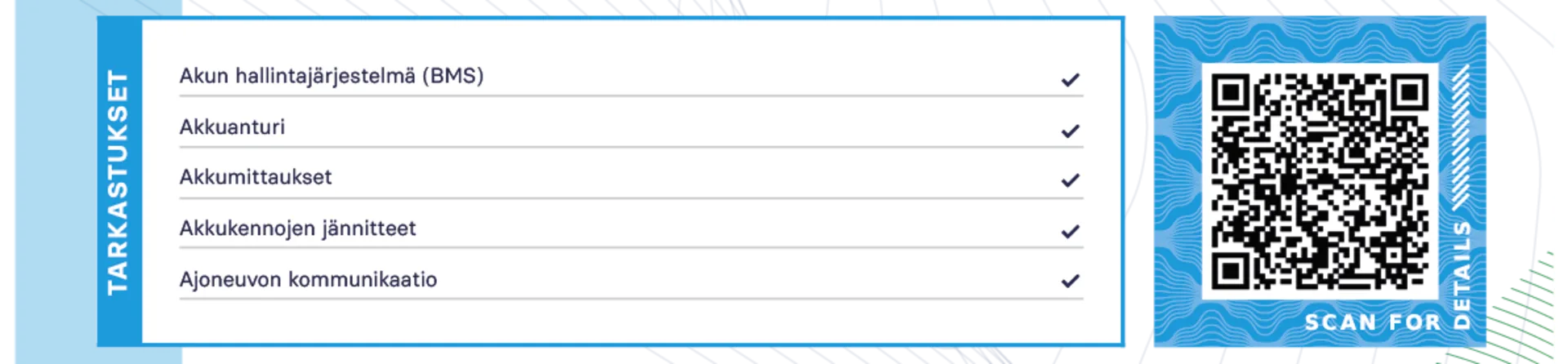
The Inspections section of the battery test summarizes what was covered in the analysis, such as the battery management system (BMS) checked for potential fault codes and battery sensors. Battery measurements and battery cell voltages are detailed further behind a QR code, along with confirmation that the vehicle communicated successfully through the test and battery interface.
Finally, the summary outlines the overall condition of the battery. This particular test vehicle passed the battery test with a clean bill of health.
If the car you're interested in hasn't had a battery test yet, contact the salesperson to request one. All plug-in hybrids and electric vehicles are tested at Saka before sale!


