
Found 4 cars




Showing 4 / 4 cars
All cars shown
Renault Trafic
Practical van for work or leisure
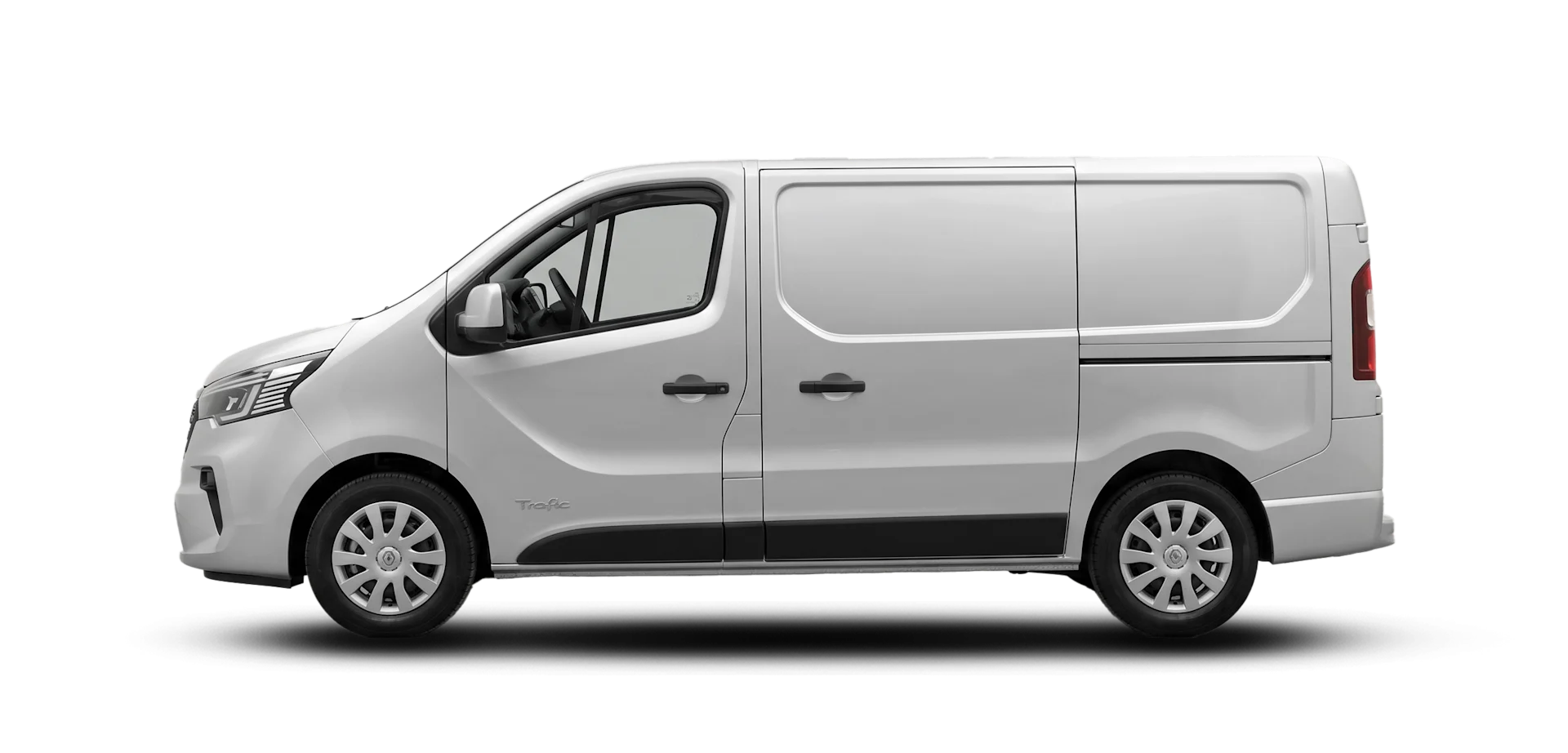
Overview
Renault Trafic at a Glance
The Renault Trafic is a mid-size van well suited for installation and maintenance work, cargo transport, and active leisure use. Its strengths include a cargo area that's easy to outfit and cab solutions that make the workday easier. Depending on the trim level, the middle front seat backrest can be folded down to serve as a work surface for a laptop or documents.
The used Trafic market is dominated by diesel models. You'll most commonly come across 1.6- and 2.0-liter engines, and in newer vehicles, automatic transmission options are available alongside manual gearboxes. The Trafic also comes in passenger transport versions as well as the fully electric E-Tech Electric.
Be sure to also browse all of Saka's used Renault vehicles. More information on the Trafic's engines, dimensions, features, and what to look for when buying can be found on the following tabs.
Who Is the Renault Trafic For?
The Trafic is a great fit for buyers who need a versatile van for everyday use. It's worth looking for the right one especially for the following needs:
- Installation and maintenance work: shelving, cargo area liners, and good lighting make it easier to work with tools and equipment.
- Delivery and gig work: a backup camera, parking sensors, and an automatic transmission make frequent stops smoother.
- A mobile workstation: cab storage compartments and a fold-down work surface (depending on trim) help keep workday essentials organized.
- Hobbies and travel: the Trafic is well suited for transporting bicycles and camping gear, and makes a solid starting point for a DIY van life build.
If you're considering it for travel use, it's worth thinking ahead about sleeping arrangements, ventilation, heating, and storage. If you'll be traveling with multiple passengers, the Trafic Combi passenger version may be a better fit than the cargo van.
Used Renault Trafic Pricing
The price of a used Renault Trafic is influenced primarily by model year, mileage, engine, transmission, body configuration, and service history. Features such as an auxiliary heater, backup camera, and pre-installed work van equipment can also add to the vehicle's practical value.
The price range is wide. At the time of review in September 2026, Saka's inventory included, for example, a 2008 diesel manual at €5,990, a 2021 diesel manual at €15,700, and a 2019 EDC automatic at €18,290. These are asking prices for individual vehicles — for current pricing and available options, check our used vehicle inventory.
Model Years and Generations
The most common Trafics on the used car market are primarily the second and third generations:
- First generation, 1980 to 2001: The original Trafic model, which was also officially sold in Finland. These are rarely found on the used market today, as even the youngest examples are over 20 years old.
- Second generation, 2001 to 2014: An older body style with a diesel lineup that included 1.9-, 2.0-, and 2.5-liter engines, among others. Vehicle age, service history, and body condition are key factors when choosing one of these.
- Third generation, from 2014 onward: The cab was redesigned and the model introduced 1.6-liter dCi diesel engines. Depending on the engine variant, one or two turbochargers are used.
- 2019 refresh: New 2.0-liter diesel engines and the EDC dual-clutch automatic transmission were added to the lineup. The front end, lighting, and cab details were also updated.
- 2022 refresh introduced to Finland: In addition to the front end, the cab received more noticeable updates. The multimedia system and available driver assistance features were improved.
- Fourth generation, Trafic E-Tech Electric: A fully electric model built on an entirely new platform designed for electric vehicles, differing fundamentally from previous generations — including rear-wheel drive and an 800-volt electrical system. The Finnish lineup and pricing are expected to be confirmed in late 2026, with the first vehicles estimated to arrive in Finland in spring 2027.
Background information can be found in Renault's 2014 introduction, the 2019 Finnish introduction, and Renault's press release covering the later refresh.
Technical Specifications
Engines and Powertrains
It's worth identifying the Trafic's engine based on displacement and model year. For example, the dCi 120 designation indicates the power class but doesn't tell you the engine size on its own.
- Older diesels: Second-generation vehicles come with various engines, including 1.9-, 2.0-, and 2.5-liter dCi units. Their maintenance needs should not be directly compared with one another.
- 1.6 dCi: The diesel engine from the early phase of the third generation. The lineup includes both single-turbo versions and twin-turbo TwinTurbo versions.
- 2.0 dCi and Blue dCi: An "engine family" available since the 2019 refresh. These come in both manual and automatic transmission options.
- E-Tech electric: The fully electric option in the lineup. The fourth-generation Trafic takes a major leap into the electric era, bringing with it an 800-volt electrical system and, according to preliminary information, a WLTP range of up to 450 kilometers.
Not all Trafic automatics are the same: among used models you'll find a six-speed EDC dual-clutch automatic, while the newer diesel lineup features a nine-speed EAG9 automatic.
Drive Configurations
Second- and third-generation standard Trafic diesel vans are front-wheel drive. If you regularly need four-wheel drive — for example, on job sites — this is a feature worth including in your search criteria from the start. The new Renault Trafic E-Tech electric is rear-wheel drive.
Dimensions, Cargo Space, and Towing Capacity
L1 refers to the shorter body version and L2 to the longer one. H1 is the lower roof and H2 is the higher roof version. The table below shows the dimensions for the updated third-generation diesel vans.
Feature | L1H1 | L2H1 | L2H2 |
Length | 5,080 mm | 5,480 mm | 5,480 mm |
Width without mirrors | 1,956 mm | 1,956 mm | 1,956 mm |
Width with mirrors | 2,283 mm | 2,283 mm | 2,283 mm |
Wheelbase | 3,098 mm | 3,498 mm | 3,498 mm |
Cargo floor length | 2,537 mm | 2,937 mm | 2,937 mm |
Cargo height | 1,387 mm | 1,387 mm | 1,898 mm |
Width between wheel arches | 1,268 mm | 1,268 mm | 1,268 mm |
Manufacturer-stated cargo volume | 5.8 m³ | 6.7 m³ | 8.9 m³ |
This table does not apply to all model years. Older listings may show different exterior dimensions and volume figures, so compare data for the same body version. A load-through hatch, when included in the equipment, allows long, narrow items to be transported into the front passenger area.
The stated braked towing capacity for these diesel versions is 2,500 kg, and the payload ranges from approximately 1,060 to 1,190 kg depending on the variant. Always verify the permitted weights in the individual vehicle's documentation. Fixed fittings and other accessories reduce the available payload. You can also check Renault Trafic technical specifications here.
Driving Experience and Top Features
Driving Feel, Driver Assistance, and Safety
When it comes to all-day comfort in the Trafic, the seat adjustments, armrest, and ease of use of the controls make a particular difference. During a test drive, it's worth trying both city driving and highway speeds, and assessing cabin noise based on your own needs.
Newer vehicles may be equipped with features such as active emergency braking, lane departure warning or lane assist, blind spot warning, and adaptive cruise control. Feature availability depends in practice on the model year, trim level, and optional extras selected for the vehicle.
Top Features
When comparing used Trafic vans, the following features are especially worth looking at:
- Fuel-operated auxiliary heater with timer
- Driver's seat heating, armrest, and lumbar support
- Reversing camera and parking sensors
- Cruise control
- LED headlights
- Automatic transmission
- Phone connectivity and possible Apple CarPlay or Android Auto
- Folding work surface and cab storage solutions
- Cargo area plywood lining, shelving, and lighting
- Number of side doors and rear door configuration
The Navi Edition, Nordic Edition, and Premium Edition trim levels can help give you a general idea of a vehicle's equipment, but it's still worth checking the specific features of each individual vehicle in the listing.
Buyer's Guide
What to check when buying a used Renault Trafic?
Previous use has a significant impact on a van's condition. That's why, alongside the service history and test drive, it's worth looking into how the vehicle was used by its previous owner.
- Service history: check service dates, mileage readings, and repairs carried out. Also find out which services are coming up next.
- Engine operation: try a cold start and listen for any unusual sounds. The engine should run smoothly without hesitation or warning lights.
- Turbo and intake system: pay attention during the test drive to power delivery, unusual whistling, and visible leaks.
- Emissions systems: check for any recalls and repairs related to the particulate filter, EGR, and any AdBlue system fitted to the vehicle.
- Manual transmission: try all gears and listen for any whining noises. Also check clutch operation during pull-aways.
- Automatic transmission: test pull-aways, reversing, and gear changes both cold and warm. Confirm that transmission-specific services have been carried out.
- Body and doors: inspect the sills, skirts, rust damage, and the operation of the sliding and rear doors.
- Cargo area and fittings: check the condition of the floor, lashing points, and shelf mountings.
- Heating and electrical equipment: test the auxiliary heater, air conditioning, camera, locks, and multimedia system.
Renault's service schedule is model-specific. If the schedule is missing, you can request it from a dealer using the registration or VIN number. You can find Renault's instructions for checking the service schedule here.
Running and maintenance costs
Generally speaking, the running costs of the Renault Trafic are considered reasonable. It's worth comparing operating costs against diesel vans of a similar age. A low purchase price alone doesn't determine the total cost of ownership if major services are coming up soon.
In addition to fuel, costs arise from scheduled maintenance, tires, brakes, and insurance. Consumption is affected by load, speed, and to some extent the use of auxiliary heaters. For business use, it's also worth factoring in downtime during servicing and the potential need for a replacement vehicle.
1.6 dCi or 2.0 dCi?
The 1.6-liter Trafic is worth considering if you're looking for a more affordable third-generation vehicle and a suitable example with a good service history can be found. The engine comes in several power outputs, so displacement alone doesn't tell the whole story about performance.
The 2.0-liter engine introduced after the 2019 refresh is a natural choice if you want a newer vehicle or the EDC automatic transmission. Those who frequently drive with heavy loads should pay particular attention to engine power and torque figures.
- Choose the 1.6 dCi if you can find a well-maintained example that suits your needs at a lower price.
- Choose the newer 2.0 dCi if you prioritize a more recent model year, a more powerful engine variant, or an automatic transmission.
Manual or automatic?
An automatic makes driving easier in traffic and during workdays with frequent stop-and-go situations. A manual can be a good choice for more consistent highway driving or when the purchase price is the deciding factor.
When comparing automatics, also look into the transmission type. The EDC and the newer EAG9 are different solutions, and it's worth test driving both to get a feel for them yourself.
- Choose the automatic if you value effortless city driving and frequently travel routes with many stops.
- Choose the manual if a stick shift suits your driving style and it helps you find a vehicle that better fits your budget.
Competitors and Comparison
Comparison Between Renault Models
- Renault Kangoo: a compact van suited for urban deliveries, service calls, and light transport.
- Renault Master: a larger commercial vehicle with a lineup that includes options for cargo transport and various specialized uses.
Comparison With Competitors
- Ford Transit Custom: a mid-size van with a range of powertrain options and practical equipment solutions to support your work.
- Volkswagen Transporter: a versatile van lineup for work, passenger, and leisure transport.
- Mercedes-Benz Vito: a mid-size commercial vehicle with a used inventory that includes various drivetrain configurations and trim levels.
Summary
The Trafic is especially well suited for buyers looking for a diesel van for installation, maintenance, or delivery work. A pre-equipped unit can also serve well for combining work and hobbies.
When comparing it to the Transit Custom, it's worth focusing on driving feel, cab usability, and features. If you need four-wheel drive, be sure to also explore the Transporter and Vito options. The smaller Kangoo may be more convenient for light urban work, while the Master offers an alternative for larger transport needs.
When choosing the right unit, the deciding factors ultimately come down to service history, equipment suited to your intended use, and total cost of ownership. Browse your options on Saka's used vehicles page.
Renault Trafic – Frequently Asked Questions
Is the Renault Trafic a good used vehicle?
Yes, the Renault Trafic is a solid choice as a used work vehicle, particularly thanks to its practical cargo space and driver-friendly cab solutions that make the workday easier. A well-maintained example is also suitable for high-mileage drivers. When making a purchase decision, it's worth focusing on the service history, the condition of the engine and transmission, and any signs of previous heavy use.
Does the Renault Trafic have a timing belt or a timing chain?
The Trafic's 1.6 dCi and 2.0 dCi diesel engines use a timing chain. The older 1.9- and 2.5-liter diesel engines have a timing belt. It's worth confirming the timing system based on the specific engine version.
Does the Renault Trafic's timing chain need to be replaced?
A timing chain generally doesn't have a scheduled replacement interval like a timing belt does. The chain is replaced as needed based on its condition, so unusual rattling, for example, is a reason for inspection. Regular oil changes are important in chain-driven engines as well.
Is the Renault Trafic available with an automatic transmission?
Yes. Newer 2.0-liter diesel models are available with a six-speed EDC dual-clutch automatic transmission, and more recent models feature a nine-speed EAG9 automatic. The type of transmission depends on the vehicle's model year and trim level.
Is the Renault Trafic available with four-wheel drive?
Second- and third-generation standard Trafic diesel vans are front-wheel drive. If four-wheel drive is a must, it's worth considering alternatives such as the Volkswagen Transporter and Mercedes-Benz Vito, both of which are available in four-wheel-drive versions.
Is there an electric version of the Renault Trafic?
In the used vehicle market, the Renault Trafic is currently only available in Finland with diesel engines (130, 150, or 170 hp). An electric version has not yet been delivered to the Finnish market, but Renault has unveiled the all-new, fourth-generation Trafic E-Tech Electric, which brings rear-wheel drive, an 800-volt charging architecture, and a WLTP range of up to 450 kilometers. The Finnish lineup and pricing are expected to be confirmed in late 2026, with the first vehicles estimated to arrive in Finland in spring 2027.
Is the Renault Trafic suitable for camping and van life?
Yes. The Trafic is well suited for transporting recreational gear and serves as a great starting point for a custom camper build. When choosing the right vehicle, it's worth thinking about sleeping arrangements, ventilation, heating, and the need for passenger seating.
Easy car deals at Saka!
Saka is Finland's largest used-car dealer, and our operations are built on strict quality control. We select only the best examples among used cars and make sure every car we sell lives up to our promises.
Every used car priced over €10,000 that comes up for sale at Saka undergoes an independent third-party condition inspection, and the key findings are compiled for the customer in the Rehti certificate – the new standard for used-car condition inspections.
Why buy a car from Saka?
- Thorough condition inspection and the Rehti certificate: Our used cars priced over €10,000 undergo an independent third-party condition inspection, and the batteries of electric cars and plug-in hybrids are tested with the Aviloo battery test. The key findings of the inspection are compiled for the customer in the Rehti certificate. Read more about the Rehti certificate, the condition inspection and the battery test.
- Flexible car financing: We offer ready-negotiated financing, letting you pay for your car easily in even monthly instalments – even without a down payment if needed.
- Trading in your car: Sell us your old car! We buy cars under 10 years old with under 225,000 km on the clock. When you buy a car from us, we'll take your old car in trade.
- Home delivery: We deliver the car of your dreams to a Saka showroom or straight to your front door anywhere in Finland. Read more about home delivery.
On our site you'll also find plenty of information on different car models and fuel types. On our media page you'll find, besides our sweepstakes, things like:
- Guides to buying an electric car, a hybrid car and a used car
- Test-drive videos, where experienced car journalist Anniina Pohjonen test-drives Saka's most popular cars
- Tip videos, where our car salespeople answer the most common questions about choosing a car
- Stylish vibe videos of the most popular car models
Interested in a Trafic?
Get in touch!Contact one of our experts and find the perfect Trafic for you.