
Found 1 cars

Ford Galaxy
High-quality 7-seater minivan
Overview
Ford Galaxy in Brief
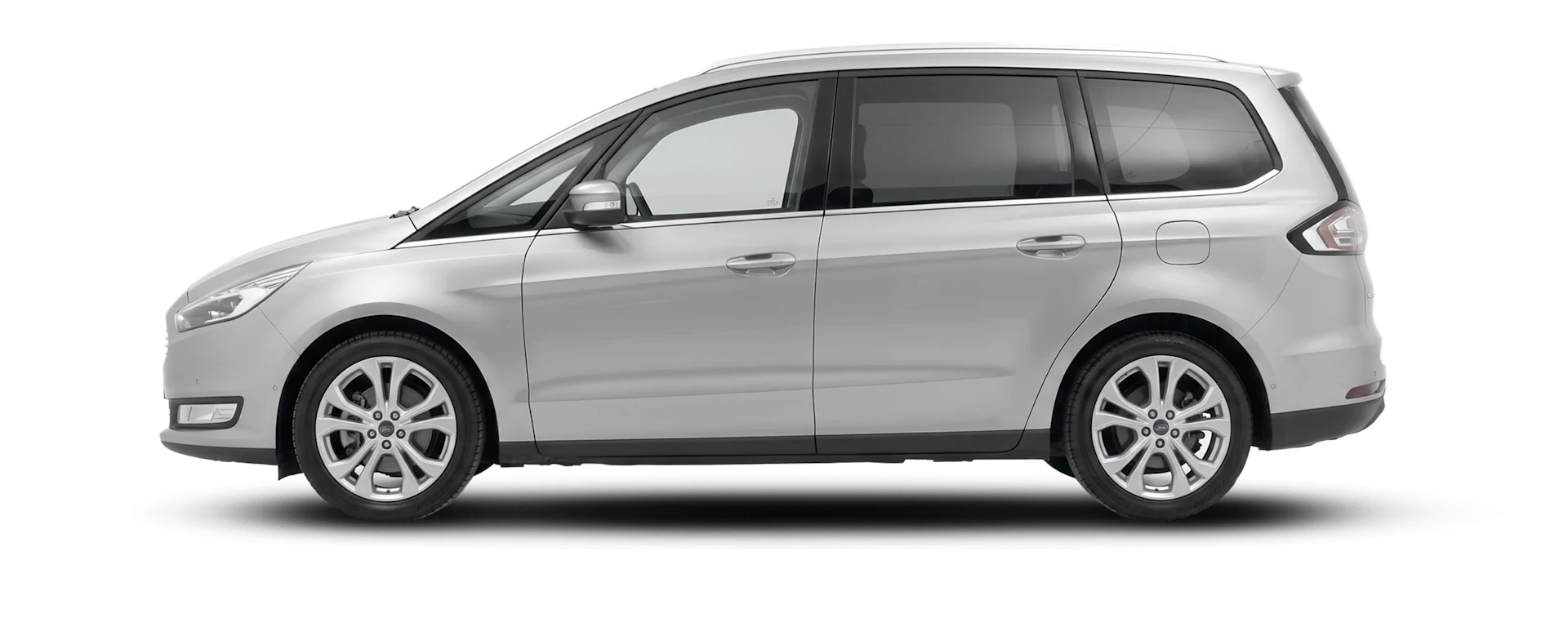
The Ford Galaxy is a large 7-seat minivan where every seat is part of a practical family car package. Its tall and long body offers more space in the third row than many seven-seat SUVs. When the rear seats aren't needed, they fold flat into the floor, creating a large, level cargo area.
The used car market in Finland is dominated by second- and third-generation diesel models. Both manual and automatic transmissions are available, and the third generation also offers four-wheel-drive diesels and full hybrids.
Also check out other used Ford vehicles.
Who Is the Ford Galaxy For?
The Galaxy is a great fit for buyers who want generous space and quality. It's comfortable to drive and well-suited for situations where passengers and cargo are transported on a regular basis.
- For large families or multi-passenger trips: three separate second-row seats make it easier to position child seats, and the third row is accessed by tilting the middle-row seats. The high roofline makes the rearmost seats more usable for larger passengers than many lower alternatives.
- For recreational and vacation trips: the third row can be folded down when more cargo space is needed.
- For long-distance driving: a stable ride, a spacious cabin, and extensive comfort features are well-suited for highway-focused driving.
- For winter conditions: some third-generation diesel models come with four-wheel drive, which is helpful in winter conditions and rougher terrain.
Used Ford Galaxy Pricing
The price of a Galaxy is influenced primarily by generation, mileage, engine, transmission, drivetrain, and trim level. A documented service history, a fuel-powered auxiliary heater, other optional equipment, and a tow hitch are also important factors when buying a used car.
At the time of review in September 2026, Saka's inventory included one 2016 Ford Galaxy 2.0 TDCi 150 hp PowerShift Titanium Business. The car had 264,000 kilometers on the odometer and was priced at €13,190. This is just one individual example, however — for current vehicles and pricing, see the listings on this page.
Model Years and Generations
There are three distinctly different generations under the Galaxy name. When choosing a used car, it's worth paying attention not only to the model year but also to the generation, engine, and transmission.
- 1st generation, 1995–2006: developed jointly with Volkswagen and SEAT, making it closely related to the first-generation Volkswagen Sharan and SEAT Alhambra. The model received a significant refresh in 2000.
- 2nd generation, 2006–2015: Ford's own model, sharing technology with the S-MAX and Mondeo of the era. The 2010 update brought changes to the exterior, engines, and equipment.
- 3rd generation, 2015–2023: a complete redesign that retained the core concept of seven individual seats. Diesel technology and automatic transmissions evolved throughout the model run, and the 2019 mid-cycle refresh updated the exterior and equipment.
- Galaxy Hybrid, from 2021: a full hybrid combining a 2.5-liter gasoline engine with an electric motor.
- Production ended in 2023: the Galaxy did not receive a direct successor, which makes the age, mileage, and service history of used examples all the more important when choosing the right one.
The following tabs contain detailed information on the Galaxy's engines, transmissions, dimensions, features, buyer's checklist, and competitors.
Technical Specifications
Engines and Powertrains
The Galaxy's engine lineup varies significantly by generation and market. In the Finnish used car market, diesel engines are common, but gasoline models and the latest generation's full hybrids are also available:
- First-generation engines: the lineup included 1.9 TDI diesels and several gasoline options. Due to the Volkswagen partnership, the engines used in these vehicles differ from the Ford engines found in later Galaxy models.
- Second-generation TDCi diesels: used examples come with 1.8-, 2.0-, and 2.2-liter versions.
- Second-generation gasoline engines: the lineup featured naturally aspirated gasoline engines and, later, EcoBoost turbocharged engines. Their availability in Finland is more limited compared to diesel models.
- Third-generation 2.0 TDCi: the most popular diesel model in the early years of the generation, available in several power outputs. It came with a manual transmission or a six-speed PowerShift automatic.
- 2.0 EcoBlue: introduced in the later third-generation lineup. Paired with either a six-speed manual or an eight-speed automatic transmission.
- 2.5 Hybrid: the full hybrid uses a gasoline engine, an electric motor, and a continuously variable transmission. It can run on electricity alone at times without external charging, but it is not a plug-in hybrid.
Transmissions and All-Wheel Drive
The Galaxy is available with both manual and automatic transmissions. The PowerShift is a six-speed dual-clutch transmission, which operates differently from a traditional torque converter automatic. Later third-generation EcoBlue diesel models used an eight-speed automatic transmission. The hybrid has its own continuously variable drivetrain.
The first and second generations are essentially front-wheel drive. All-wheel drive versions were also produced for the third-generation 2.0-liter diesels. All-wheel drive was not available in every power and transmission combination.
Dimensions, Cargo Space, and Towing Capacity
The dimensions below refer to the third generation, introduced in 2015, which is currently the most popular version on the used car market.
Feature | Ford Galaxy, 3rd Generation |
Length | 4,848 mm |
Width without mirrors | 1,916 mm |
Height | 1,747 mm |
Wheelbase | 2,850 mm |
Cargo space with seven seats | 300 L |
Maximum cargo volume | 2,339 L |
With all seven seats in use, the cargo space is sufficient for everyday items, but fitting luggage for a large family requires some planning. Folding down the third row significantly increases the available space. Towing capacity depends on the engine, transmission, and drivetrain. In third-generation diesel models, the maximum permitted mass for a braked trailer can be up to approximately 2,000 kilograms, and in the hybrid up to 1,750 kilograms depending on the version. The value stated on the vehicle registration document is the one that applies.
Driving Experience and Top Features
A Comfortable and Stable Minivan
The Galaxy is large in terms of exterior dimensions, but thanks to its car-like platform, it doesn't feel like a van to drive. Its strengths include relaxed highway driving, good visibility, and passenger comfort. The tall body rolls more than the lower-profile S-MAX, but in return, the cabin and third-row seating are more spacious.
In the city, the nearly 4.85-meter length and wide body make parking sensors and a camera particularly useful. The Galaxy's rear doors are conventional hinged doors, not sliding doors — something worth keeping in mind in tight parking spaces and when using child seats.
Seven Individual Seats
The second row consists of three individual seats, each of which can be slid and folded independently. The two third-row seats fold flat into the cargo floor. In the third generation, all three second-row seating positions are equipped with ISOFIX anchors, making it easier to install multiple child seats. The compatibility of a child seat must still be verified using the seat and vehicle instructions.
Top Features
When shopping for a used Galaxy, it's especially worth comparing the following useful features:
- fuel-operated auxiliary heater
- heated windshield, steering wheel, and seats
- front and rear parking sensors and a backup camera
- power-folding rear seats
- three-zone climate control and rear passenger ventilation
- adaptive cruise control
- LED headlights or adaptive headlights
- trailer hitch
- keyless entry and a power liftgate
- Apple CarPlay and Android Auto in newer infotainment systems
Trim levels such as Trend, Titanium, and Vignale give a general idea of what standard features a particular vehicle includes.
Buyer's Guide
Maintenance and Running Costs
The Galaxy is a large and heavy minivan, so its fuel, tire, brake, and tax costs are generally higher than those of smaller seven-seat vehicles. However, overall maintenance costs are roughly on par with the Ford S-MAX, Volkswagen Sharan, and Seat Alhambra. Compared to large premium SUVs, the Galaxy is typically less expensive to service and equip with tires. The cost risk for any individual vehicle is particularly influenced by the engine, transmission, drivetrain, mileage, and documented service history.
Key factors in the service history include engine-specific timing system maintenance, automatic transmission requirements, and the condition of diesel emissions systems. Not all Galaxy models share the same timing system or transmission. When estimating future costs, it is worth checking the vehicle's service schedule and comparing it against the work that has actually been carried out.
Comparison Vehicle | Galaxy Cost Level |
Ford S-MAX | Very close to the Galaxy |
Volkswagen Sharan | Very close to the Galaxy |
Seat Alhambra | Very close to the Galaxy |
Volkswagen Touran | Galaxy generally more expensive |
Citroën Grand C4 Picasso | Galaxy generally slightly more expensive |
Volvo XC90, Audi Q7 | Galaxy generally significantly less expensive |
What Should You Check on a Used Ford Galaxy?
Checklist
- Service history: review completed scheduled services and any repairs, and identify upcoming maintenance work. Determine the engine version before assessing timing system service needs.
- PowerShift automatic transmission: verify from service records that the transmission fluid and filter have been changed according to the service program specific to this transmission. During a test drive, gear changes and pull-away should be smooth and consistent both cold and warm.
- Diesel engine: find out as much as possible about the vehicle's usage history and any repairs made to the emissions system. Frequent short trips are not as favorable for the diesel particulate filter as regular longer drives.
- Seats and safety equipment: test the sliding, folding, locking, and seat belts on all seats. Also check the child seat anchor points and access to the third row.
- Air conditioning and heating: test the air conditioning on all seating rows as well as any auxiliary heater. Heating and cooling a large cabin matters in everyday use.
- Electrical features: test the cameras, parking sensors, multimedia system, power tailgate, keyless entry, and power-folding rear seats.
- Suspension, brakes, and tires: check for even tire wear and assess during the test drive whether the vehicle tracks straight and brakes in a straight line. The high curb weight and load capacity affect the service life of wear components.
- Body and interior: inspect door edges, sills, the tailgate, cargo area trim, and any signs of previous repairs. The seven-seat interior is worth examining with the seats both up and folded.
Diesel, Gasoline, or Hybrid?
- Choose diesel if you do a lot of highway driving, need towing capacity, or frequently carry a full load. Long trips also suit the operating requirements of a diesel particulate filter.
- Choose gasoline if your annual mileage is moderate and a well-maintained example can be found. Gasoline models are less common than diesel ones.
- Choose full hybrid if you want an automatic and do a lot of city or suburban driving without needing to plug in. Hybrid availability is limited, and towing capacity and front-wheel drive should be matched to your needs.
Manual or Automatic?
- Manual often provides more options in older and more affordable inventory. It suits drivers who are comfortable shifting gears in city and stop-and-go traffic.
- Automatic makes driving a large vehicle easier in urban settings and when towing, but the transmission type and service history must be identified. The PowerShift, the eight-speed automatic, and the hybrid powertrain are not the same transmission.
Front-Wheel Drive or All-Wheel Drive?
Front-wheel drive is the most common drivetrain configuration in the Galaxy and, with good tires, is sufficient for most drivers. The third-generation all-wheel-drive diesel is a justified choice if you regularly drive on snowy back roads, tow a trailer in slippery conditions, or need extra traction. All-wheel drive also narrows the available engine and transmission options.
Competitors and Comparison
Comparison Between Ford Models
- Ford S-MAX is lower and has a more car-like driving feel as a seven-seater. The Galaxy is worth considering when third-row headroom and cargo space with all seven seats occupied matter more.
- Ford Grand C-MAX is a more compact seven-seater with practical sliding doors. Its third row and cargo space are smaller than the Galaxy's.
- Ford Tourneo Connect offers an upright body and sliding doors. The driving feel and interior layout are more van-like than the Galaxy's.
Comparison With Competitors
- Volkswagen Sharan is the Galaxy's closest rival, featuring sliding rear doors. These make it easier to manage in tight parking spaces, especially with children.
- Seat Alhambra shares much of its technology with the Sharan and offers sliding doors along with seven seats.
- Volkswagen Touran is smaller in overall dimensions. It's a good fit if seven seats are only needed occasionally and a more manageable size in the city is a priority.
- Citroën Grand C4 Picasso is a lighter-feeling seven-seat family car. The Galaxy offers a larger and taller cabin along with more space for regular use by seven passengers.
Summary
The Galaxy stands out from its competitors primarily thanks to its third-row space, tall cabin, and cargo area that expands generously. The S-MAX is a better fit for buyers who prioritize a lower roofline and a more car-like feel. The Sharan and Alhambra are strong alternatives when sliding doors are a deciding factor for family use.
When choosing a used minivan, a solid service history, the right seating configuration, and well-functioning comfort features can matter more than the brand. Be sure to also explore other great options on Saka's used cars page.
Ford Galaxy – Frequently Asked Questions
Is the Ford Galaxy a seven-seater?
Yes, in the Finnish market the Galaxy is known as a seven-seat minivan.
What is the difference between the Ford Galaxy and the S-MAX?
The Galaxy is taller and more spacious, particularly in the third-row seating area. The S-MAX is lower and has a sportier driving feel. The Galaxy is better suited for regular use with seven passengers.
Does the Ford Galaxy have sliding doors?
No. The Galaxy has conventional hinged rear doors. Those who need sliding doors should look at options such as the Ford Grand C-MAX, Volkswagen Sharan, or Seat Alhambra.
Does the Ford Galaxy have all-wheel drive?
Some third-generation 2.0-liter diesel variants are available with all-wheel drive. First- and second-generation Galaxy models, as well as the Galaxy Hybrid, are front-wheel drive.
Does the Ford Galaxy have a timing belt or a timing chain?
The Galaxy has both, as the model has used several different engine families. The timing system configuration and any recommended replacement interval should be verified based on the engine code, model year, and the current service schedule.
What does PowerShift mean in the Ford Galaxy?
PowerShift is a six-speed dual-clutch automatic transmission. When buying a used vehicle, it is important to verify that the transmission fluid and filter services have been performed in accordance with the service schedule for that specific variant.
How large is the Ford Galaxy's cargo area with all seven seats in use?
In the third-generation Galaxy, the manufacturer states a cargo capacity of 300 liters with all seven seats occupied. Folding down the third row significantly increases the available space.
Is the Ford Galaxy still in production?
No. Galaxy production ended in 2023, and no direct successor was introduced.
Easy car deals at Saka!
Saka is Finland's largest used car dealership, and our operations are based on strict quality control. We screen the used car inventory to select only the best vehicles and ensure that every car we sell meets our promises.
- Flexible car financing: We offer pre-negotiated financing that allows you to pay for your car in easy monthly installments – if needed, even without a down payment.
- Trading in your car: Sell us your old car! We buy cars less than 10 years old with under 225,000 km on the odometer, and we accept them as trade-ins when you upgrade to a newer car.
- Home delivery: We deliver your dream car to Saka dealerships or directly to your doorstep anywhere in Finland. Read more about delivery.
- Vehicle inspection: All of our used cars priced over 10,000 euros undergo a condition inspection by a third party. Read more about the condition inspection here.
- Battery test: The drive batteries of our cars are tested at Saka using the Austrian Aviloo battery test. Read more about the battery test here.
Interested in a Galaxy?
Get in touch!Contact one of our experts and find the perfect Galaxy for you.